The short answer
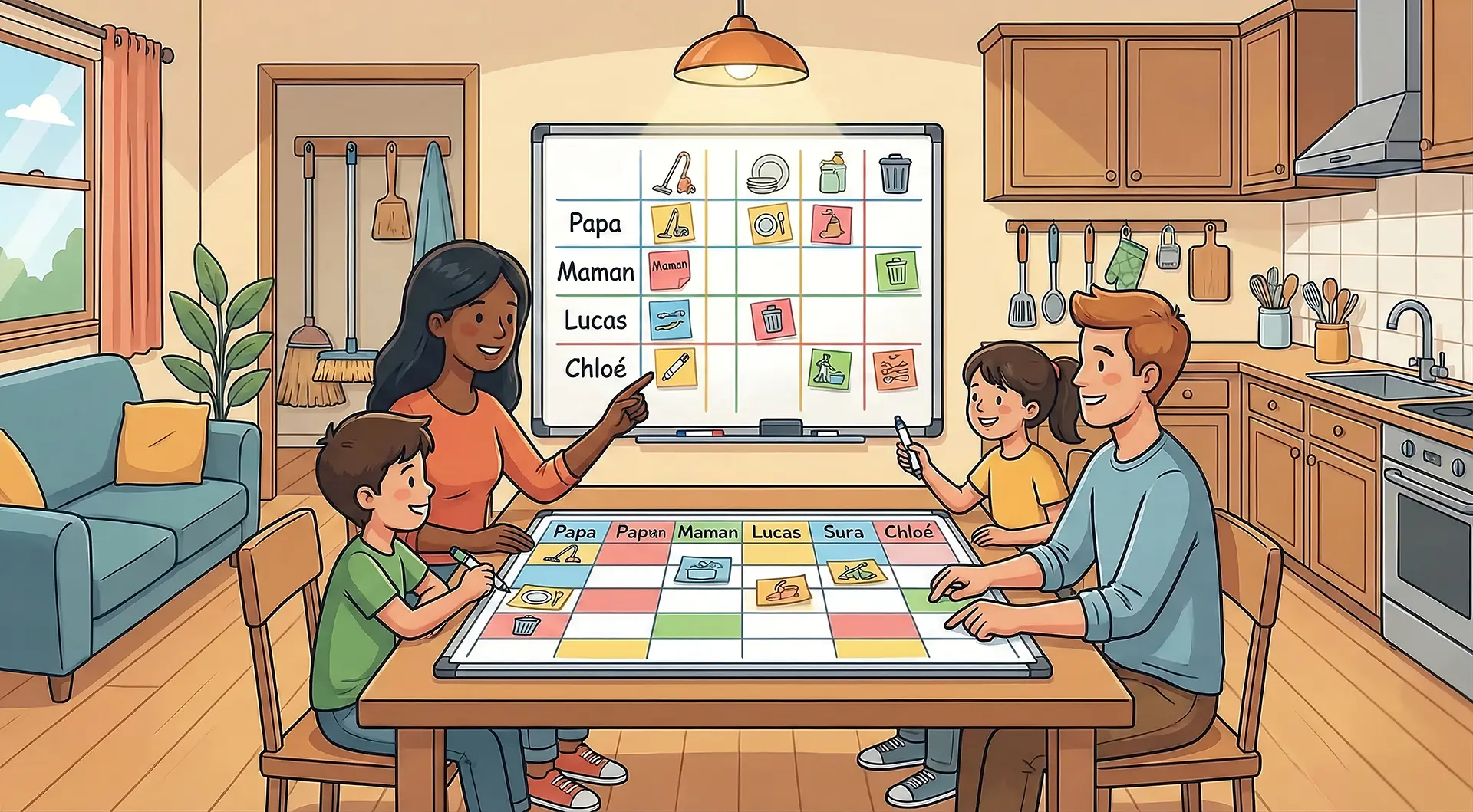
To divide household chores fairly in a family, handing out jobs at random isn’t enough: tasks aren’t all equal, not all of them concern everyone, and many of them go unseen. The method comes down to five steps.
- Together, list everything that keeps coming back, invisible tasks included: planning ahead, remembering, restocking.
- Give each task a value, based on the effort it takes: cleaning the bathroom weighs more than clearing the table.
- Decide, for each task, who it concerns: what one person does only counts for those the task really concerns.
- Give children the tasks their age allows, and give them more as they grow.
- Take stock every week, and adjust whatever is no longer working.
The sections below go through each step in detail, then two special situations: the family with a baby or young children, and organizing the week.
Step 1: Take a complete inventory of tasks
Before distributing anything, you first need to visualize all the invisible work. Gather the whole family and list together all the household tasks:
Daily tasks
- Prepare meals (breakfast, lunch, dinner)
- Do the dishes or load/unload the dishwasher
- Clear and clean the table
- Tidy common areas
- Take out the trash
Weekly tasks
- Vacuum
- Clean floors
- Do laundry and hang clothes to dry
- Iron
- Clean the bathroom
- Grocery shopping
Monthly or occasional tasks
- Deep cleaning
- Wash windows
- Organize closets
- Garden maintenance
Invisible tasks
- Plan the week’s meals
- Remember appointments: doctor, school, activities
- Restock what you need before you run out
This exercise is often eye-opening: many tasks are performed automatically by a single person, without the rest of the family being aware of it.
FairChore puts this idea to work every day: every task is worth points, and the household total always stays at zero. That's why it's meant for more than one person: create the household, then send the invitation link to the people you live with. Free, ad-free, nothing to install.
Create our household for freeStep 2: Assign points based on difficulty
Not all tasks are equal. Washing 3 plates is not comparable to cleaning the entire bathroom. The point system lets you take into account the effort each task requires.
Here’s an example scale:
- 5 points: Clear the table, take out the trash
- 10 points: Do the dishes, tidy the living room
- 15 points: Vacuum, do a complete load of laundry
- 20 points: Prepare a meal, clean the bathroom
- 30 points: Complete kitchen cleaning, major housework
This is what FairChore makes possible. When the household is created, FairChore already suggests a list of common tasks, sorted by category, each with its value in points; the parent who created the household can add to it, rename a task or change its value, and give the other parent the same right by making them an admin.
Balancing the points
Points should reflect how hard a task feels to your family. Observe behaviors:
- No one wants to do a task? The points are too low. Increase them! If “Clean the toilets” at 10 points doesn’t attract anyone, raise it to 20 or 25 points.
- Everyone is fighting over a task? The points are too high. Lower them! If “Water the plants” at 15 points creates disputes, reduce to 5 points.
It’s the law of supply and demand applied to chores: the right value for a task is the one at which someone agrees to do it.
Step 3: The debt/credit system explained
In FairChore, the principle is simple. When someone does a task, its value is shared among the people concerned: whoever did it earns points, and the others concerned owe their share. The household total stays at zero.
Each person’s balance accumulates from the first day: it is never reset to zero. In a family, then, it tells you by how much each person is above or below their share.
Concrete example
Imagine a family of 4 people: Dad, Mom, Lea (14 years old), and Tom (8 years old). Dad prepares dinner (20 points).
If the whole family is involved:
- Dad earns: 20 - (20÷4) = +15 points
- Mom, Lea, and Tom each lose: -5 points
- Total: +15 - 5 - 5 - 5 = 0 ✓
Step 4: Adjust the affected members
Not all tasks involve all family members in the same way.
The children’s example
Tom, 8 years old, cannot reasonably be held responsible for “Prepare dinner”. This task therefore does not involve him. However, “Clear the table” very much involves him!
For each task, you choose the affected members:
- “Prepare dinner”: involves Dad, Mom, and Lea (not Tom)
- “Clear the table”: involves everyone, including Tom
A task that only concerns the person who does it, like organizing your own room, has no place in FairChore: it wouldn’t move any points, and the app doesn’t record it.
Result: when Dad cooks, Tom doesn’t lose points (he’s not involved). But when Tom clears the table, he earns points, and all the other affected members, his parents included, lose their share.
The next time
The next time, FairChore already ticks the affected members you had chosen for that task. When Tom grows up and starts helping in the kitchen, the question will come up again: does this task concern him now?
Step 5: Involve children according to their age
Children can do their share from a very early age, as long as the task suits their age. Here are some guidelines, to adapt to each child:
- 3-5 years: Put away toys, put dirty laundry in the basket
- 6-8 years: Set and clear the table, help fold laundry
- 9-12 years: Vacuum, load the dishwasher, take out the trash
- Teenagers: Prepare simple meals, do their own laundry, clean the bathroom
The youngest. For a child too young to have their own account, the parent who manages the household creates a supervised account: the child does not log in themselves. The parent who created the supervised account can switch to the child’s profile, so that it’s the child who logs what they’ve done.
Teens. According to FairChore’s Terms of Service, a teen can have their own account from age 13, with a parent’s consent if they are under 16; they then join the household through the invitation link.
For task ideas at every age, and how to present them, read our guide to involving children in household chores by age.
With a baby or young children
With a baby, the list suddenly gets much longer, and a good part of the work can’t be seen at all anymore. Childcare tasks are tasks like any other: they go on the list.
- Everyday care: preparing bottles or meals, changing, bathing, putting to bed.
- Nights: getting up, comforting, settling back to sleep. A broken night counts, even if it leaves nothing visible the next day.
- Keeping track: booking doctor’s appointments, going to them, buying diapers before they run out.
Being the parent at home on leave doesn’t mean being in charge of everything else. Looking after a baby already fills the days: the cleaning, the shopping and everyone else’s meals still have to be divided between the adults in the household.
Rebalance over the week rather than over the day. With young children, no two days are alike: whoever handled the nights early in the week can take a break on the weekend, whoever took care of the appointments can leave the shopping to the other. What matters is that the week is balanced, not every evening.
Older siblings can do their share too, in their own way: bringing a diaper, putting away the little one’s toys, setting the table while the baby eats.
Organizing the week
A division of chores only holds if you look at it from time to time. The simplest way is to set a fixed time each week, on Sunday evening or during a meal, to take stock as a family.
- One question only: what is no longer working? One thing at a time, and a decision at the end.
- Everyone speaks, children included: those who do a task often know better than the others where things get stuck.
- Adjust a value rather than repeat a complaint: a task that causes friction every week often has a value that is too low, or the wrong affected members.
Tasks that come back on fixed dates are worth scheduling. In FairChore’s Planner, a task can repeat every day, every week or every month, for one family member or for the whole household. On the day a scheduled task is due, FairChore sends a reminder to the person it’s assigned to, or to the whole household. Children with a supervised account don’t receive any, and a scheduled task assigned to one of them doesn’t trigger one.
Conclusion: take action
A fair division of household chores in the family is built step by step: the list first, a value for each task, the affected members, the children’s share according to their age, then a check-in every week.
To keep this count as a family, you can try FairChore. To bring the other parent or a teen into the household, FairChore gives you an invitation link to send them. For a child too young to have their own account, the parent who manages the household creates a supervised account: the child does not log in themselves. FairChore can be used in the browser, and on Android via Google Play.