Why involve children in household chores?
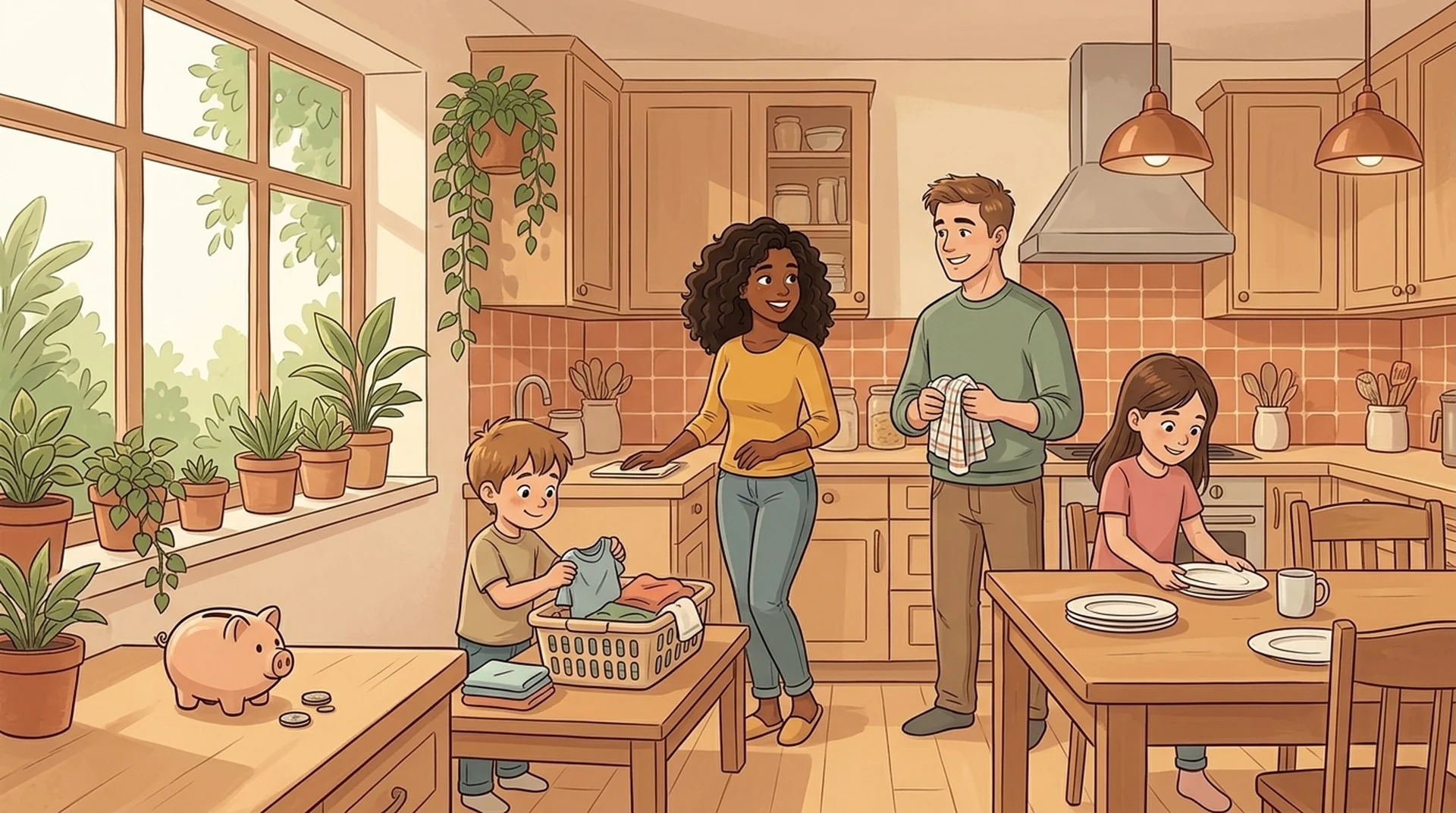
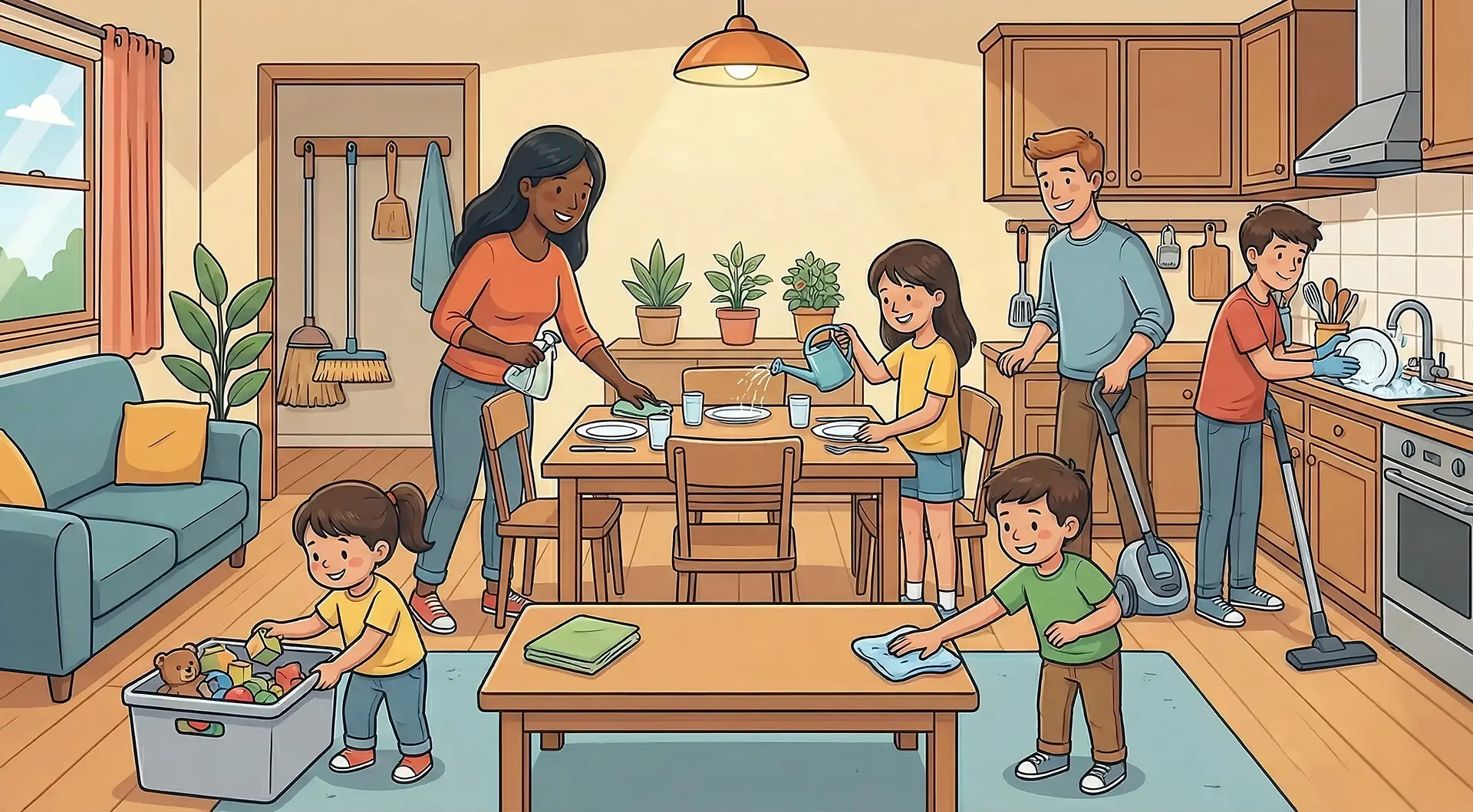
Helping out at home means learning to do things for yourself and for others; chores don't have to be a punishment. They are a school of life that prepares your children to become responsible adults.
But how do you involve a 6-year-old differently from a 15-year-old teenager? And how do you count what each person does, at their own level?
The key principle: adapt tasks to age
Not all tasks are suitable for all ages. An 8-year-old child cannot cook a complete meal, but they can perfectly well clear the table or tidy their room.
For each task, you choose the affected members. A child is therefore only counted in the tasks that concern them.
FairChore puts this idea to work every day: every task is worth points, and the household total always stays at zero. That's why it's meant for more than one person: create the household, then send the invitation link to the people you live with. Free, ad-free, nothing to install.
Create our household for freeGuide to tasks by age group
Ages 2 to 3: First steps
At this age, children love to imitate adults. Take advantage of it!
- Put away toys in a bin
- Put dirty clothes in the hamper
- Throw trash in the garbage
- Wipe a surface with a cloth
FairChore Tip: A task that only concerns the person who does it, like organizing your own room, has no place in FairChore: it wouldn’t move any points, and the app doesn’t record it. Putting away toys is one of these: at this age, it's part of learning, not a task to count. Throwing away trash or wiping the table, on the other hand, benefits the whole family. For a child too young to have their own account, the parent who manages the household creates a supervised account: the child does not log in themselves.
Ages 4 to 5: Developing autonomy
- Make their bed (even imperfectly)
- Set the table (with help)
- Put away their shoes
- Water the plants
- Feed pets
FairChore Tip: For "Feed the cat," you can tick as affected only the members old enough to take care of it: the 2-year-old baby doesn't owe a share of it.
Ages 6 to 8: Real responsibilities
The child can now accomplish tasks that benefit the whole family.
- Set and clear the table
- Load and unload the dishwasher
- Fold and put away their laundry
- Vacuum their room
- Take out the trash
- Help prepare simple meals
FairChore Tip: "Clear the table" can now concern the whole family, including the 7-year-old. When someone does a task, its value is shared among the people concerned: whoever did it earns points, and the others concerned owe their share. The household total stays at zero. The parent who created the supervised account can switch to the child’s profile, so that it’s the child who logs what they’ve done.
Ages 9 to 12: Growing autonomy
- Vacuum the entire house
- Clean the bathroom (sink, mirror)
- Do their complete laundry
- Prepare their breakfast
- Do grocery shopping with a list
- Mow the lawn (with supervision)
FairChore Tip: At this age, the child can be affected by more and more tasks. Add them progressively to routine household chores.
Teenagers (13 and up): Almost adults
- Prepare complete meals for the family
- Fully manage their laundry and ironing
- Deep clean the kitchen
- Do the weekly grocery shopping
- Babysit their siblings
- DIY and minor repairs
FairChore Tip: Teenagers can be affected by practically all tasks. According to FairChore’s Terms of Service, a teen can have their own account from age 13, with a parent’s consent if they are under 16; they then join the household through the invitation link.
Counting what each person can do
The problem with the traditional system
In a traditional point system, if Mom cooks and everyone loses points, it's unfair to the 6-year-old who couldn't do that task anyway.
The solution: affected members
When you log "Prepare dinner," you only select the members capable of doing this task (the parents and the teen). The 6-year-old is not affected: they don't lose points.
On the other hand, when the 6-year-old clears the table, everyone is affected because it's a task that everyone benefits from since everyone eats! The value is then shared among everyone, Mom and Dad included.
Result: each child is involved at their level.
No need to tick everything again
The next time, FairChore already ticks the affected members you had chosen for that task.
Adjusting as a family
Each person's balance
Each person’s balance accumulates from the first day: it is never reset to zero. Look at it together from time to time, rather than brandishing it.
Economic balance
If your child never wants to do a certain task, maybe it doesn't "pay" enough. Increase its value. Conversely, if all the children are fighting to water the plants, lower its value.
When the household is created, FairChore already suggests a list of common tasks, sorted by category, each with its value in points; the parent who created the household can add to it, rename a task or change its value, and give the other parent the same right by making them an admin.
Natural accountability
Sometimes a child's points become negative. A negative balance only means they have benefited from others' work more than they have done themselves: it's an opportunity to talk about it, not a penalty.
Tips for success
- Start early: The younger you start, the more it becomes a habit
- Be patient: A child will do less well than an adult, that's normal
- Value the effort: Notice what has been done, even if imperfectly
- Adapt progressively: Add tasks as they grow
- Lead by example: Children imitate what they see
Conclusion
Involving your children in household chores is not exploiting them: it's giving them the tools to become autonomous and responsible adults. Choosing for each task who is affected lets you adapt each person's participation to their age.
To bring the other parent or a teen into the household, FairChore gives you an invitation link to send them. For a child too young to have their own account, the parent who manages the household creates a supervised account: the child does not log in themselves. FairChore can be used in the browser, and on Android via Google Play.
And what if your child, or your teen, simply refuses to pitch in? We’ve devoted a whole article to it: how to get kids (and teens) to do chores without nagging.
And to then divide the chores among all family members, adults included, follow our 5-step method for dividing household chores in the family.